Food guides
Calories in Rice: Cooked vs Uncooked, White vs Brown
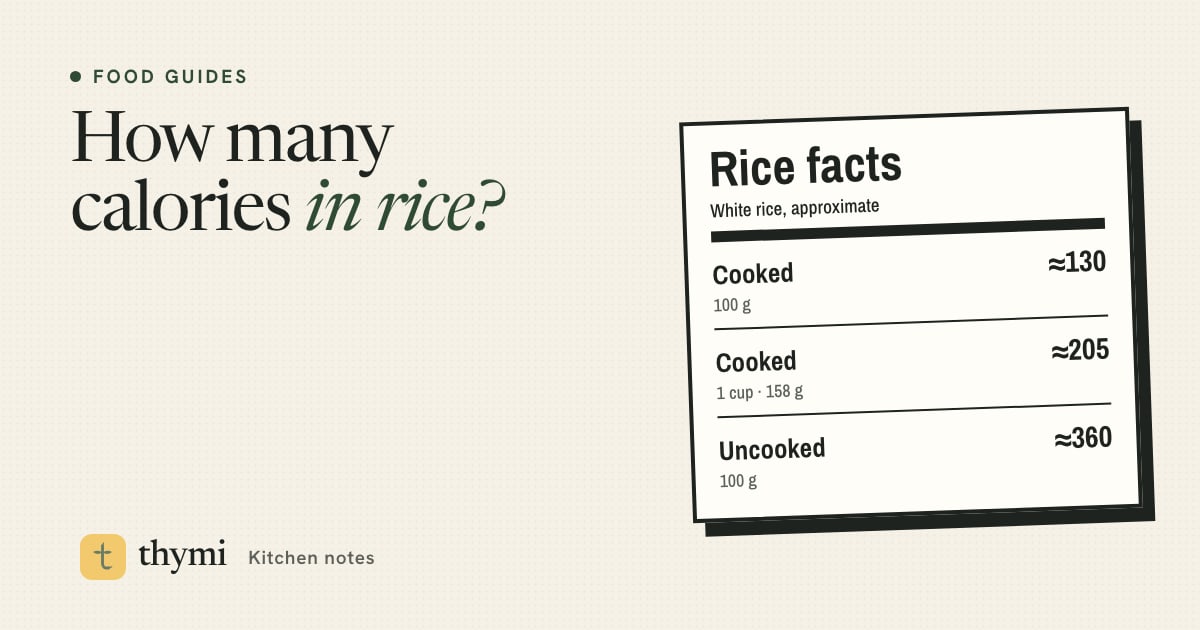
Cooked white rice has about 130 calories per 100 g (3.5 oz), or about 205 calories per cup (158 g). Uncooked white rice has about 360 calories per 100 g, because rice roughly triples in weight as it absorbs water, so the single most important thing when logging rice is to match cooked weight with a cooked entry. Brown rice is similar per gram, at about 215–250 calories per cooked cup.
Calories in rice: the quick chart
The numbers below are approximate values based on USDA data for plain rice cooked in water with no added fat or salt. Different varieties and brands vary a little, and how much water your rice absorbs changes the weight of a cup, so treat these as good working estimates.
| Rice (plain) | Per 100 g (3.5 oz) | Per cup |
|---|---|---|
| White rice, long-grain, cooked | ≈ 130 kcal | ≈ 205 kcal (158 g) |
| Brown rice, cooked | ≈ 110–125 kcal | ≈ 215–250 kcal (≈ 195–200 g) |
| Basmati or jasmine rice (white), cooked | ≈ 120–130 kcal | ≈ 190–210 kcal |
| White rice, uncooked (dry) | ≈ 360 kcal | ≈ 670 kcal (≈ 185 g) |
| Brown rice, uncooked (dry) | ≈ 360–370 kcal | ≈ 680 kcal (≈ 185 g) |
A cup of cooked white rice also has about 4 g of protein, less than 1 g of fat and well under 1 g of fiber. Cooked brown rice has about 5 g of protein and roughly 3 g of fiber per cup. Almost all of the calories in plain rice come from carbohydrate: about 45 g per cup of cooked white rice.
If you want to check a specific variety, the USDA's FoodData Central database lists cooked and raw entries for most common types.
Cooked vs uncooked rice calories: the #1 logging mistake
Dry rice is dense with starch. When you cook it, each grain absorbs water and the total weight goes up by roughly two and a half to three times. The calories do not change; they are simply spread over more grams. That is why the same rice can be "360 calories per 100 g" or "130 calories per 100 g" depending on whether you measure it before or after cooking.
The mistake happens when the weight and the database entry do not match:
- Weighing cooked rice but logging it as uncooked makes the meal look about three times bigger than it is.
- Weighing dry rice but logging it as cooked makes it look about three times smaller.
Worked example
You cook 75 g (about ⅓ cup) of dry white rice for one person. That is roughly 270 kcal. After cooking, it weighs around 210–225 g.
- Log 75 g using an uncooked entry: ≈ 270 kcal. Correct.
- Log 220 g using a cooked entry (≈ 130 kcal per 100 g): ≈ 285 kcal. Close enough.
- Log 220 g using an uncooked entry: ≈ 790 kcal. Over by about 500 kcal.
- Log 75 g using a cooked entry: ≈ 100 kcal. Under by about 170 kcal.
The two correct options land within a few percent of each other. The two mismatched ones are wildly off. If one entry in your food diary is consistently strange, a cooked-versus-raw mix-up is one of the first things to check, and it is high on our list of common calorie counting mistakes.
Tip: Cooking a pot for the whole household? Weigh the dry rice before cooking and the empty pot. After cooking, weigh the pot of rice and subtract the pot. Divide the total raw calories by the cooked weight to get a calories-per-gram figure for that batch, then weigh your own portion. For example, 300 g of dry rice (≈ 1,080 kcal) that cooks up to 870 g works out to about 124 kcal per 100 g cooked.
Because the water ratio and cooking time change how much water the rice absorbs, cooked figures can vary a little from pot to pot. Weighing dry is the most consistent method, but weighing cooked rice against a cooked entry is accurate enough for everyday tracking.
White vs brown rice calories
Per gram, white and brown rice are close in calories. Brown rice is a whole grain: it keeps the bran and germ that are milled off to make white rice. That gives it more fiber, plus a bit more protein and some extra minerals and B vitamins. Per cup, brown rice can come out slightly higher in calories than white, mostly because a cup of cooked brown rice tends to weigh a little more.
| Per cup, cooked (approx.) | White rice | Brown rice |
|---|---|---|
| Calories | ≈ 205 | ≈ 215–250 |
| Carbohydrate | ≈ 45 g | ≈ 45–52 g |
| Protein | ≈ 4 g | ≈ 5 g |
| Fiber | ≈ 0.6 g | ≈ 3 g |
So if your aim is to lower calories, swapping white for brown rice will not change much on its own. The more useful difference is fiber: brown rice is more filling for some people and helps toward a daily fiber target. That said, white rice is a staple in many cuisines and fits perfectly well into a balanced diet. Choose the one you enjoy and will actually eat, and pair it with dal, beans, vegetables or a protein source.
Basmati, jasmine and other varieties
Most white rice varieties are very similar in calories once cooked:
- Basmati. Long, fragrant grains popular in Indian and Middle Eastern cooking. Plain cooked basmati is roughly 120–130 kcal per 100 g, close to other white rice. Brown basmati is similar to other brown rice.
- Jasmine. Slightly sticky and fragrant, common in Thai and Southeast Asian food. Roughly the same as other white rice per 100 g cooked.
- Parboiled rice. Partly boiled in the husk before milling, common in South India and sold as "converted" rice in the US. Calories per cooked gram are in the same range as white rice.
- Sushi rice. Short-grain white rice that is seasoned with rice vinegar, sugar and salt, which adds a small number of calories on top of the plain rice.
The type of rice matters much less than two other things: how much of it you eat, and what is cooked into it.
Calories in jeera rice, fried rice and biryani
Once rice is cooked with oil, ghee, nuts, meat or vegetables, the numbers change a lot. The ranges below are approximate for a 1-cup serving and depend heavily on the recipe, especially the amount of fat.
| Rice dish (1 cup) | Calories (approx.) | What drives the range |
|---|---|---|
| Plain white rice | ≈ 205 | Water absorbed, cup packing |
| Jeera rice | ≈ 230–300 | Ghee or oil in the tempering |
| Vegetable pulao | ≈ 230–320 | Oil or ghee, nuts, amount of vegetables |
| Lemon rice | ≈ 230–300 | Oil and peanuts in the tempering |
| Fried rice (restaurant or takeaway style) | ≈ 230–350 | Oil, egg, meat, sauces |
| Vegetable biryani | ≈ 250–350 | Ghee, fried onions, paneer or nuts |
| Chicken biryani | ≈ 300–450 | Ghee, meat-to-rice ratio, fried onions |
The jump from plain rice to jeera rice is mostly the fat: a teaspoon of ghee is about 40–45 kcal, and a tablespoon is about three times that. Restaurant and celebration versions usually sit at the top of each range or above it. A plate of biryani at a restaurant can easily be two or three cups, so the portion matters as much as the recipe.
For more everyday dishes, including roti, dal and curries, see our guide to calories in Indian food.
Good to know: When you make jeera rice, pulao or biryani at home, log the plain rice and the fat separately, or work out the whole pot (rice, oil, ghee, nuts, meat) and divide by the number of portions. Either approach is far more accurate than picking a random "biryani" entry.
How much rice is a portion?
There is no single correct portion of rice; it depends on your calorie budget, how active you are and what else is on the plate. A few practical reference points:
- 1 cup of cooked rice is about the size of a closed fist or a tennis ball, and roughly 205 kcal for plain white rice.
- ½ cup (about 100 kcal) is a common side portion when rice sits next to curry, dal or stir-fry.
- A katori (small Indian bowl) varies a lot by household. Fill yours with rice once, tip it into a measuring cup, and you will know what "one katori" means at your table.
- Restaurant portions are often generous. A takeaway container or a heaped plate can hold two cups or more.
If you do not have a scale, our guide to estimating portion sizes without a scale has more hand-size comparisons.
A simple plate for most meals
A useful starting point is to fill about a quarter of the plate with rice, a quarter with a protein source (dal, rajma, chana, paneer, chicken, fish, eggs or tofu) and half with vegetables or salad. It keeps rice on the plate while making the meal more filling for the calories.
Can you eat rice and lose weight?
Yes. Weight loss comes from eating fewer calories than you use over time, not from cutting out any single food. Many people lose weight while eating rice every day; they simply fit their usual portion into their calorie budget.
Rice is mostly carbohydrate, so if you are following a specific carb target, it is worth knowing that a cup of cooked white rice is about 45 g of carbs. Our guide to how many carbs you need a day explains how that fits into a daily total. A few habits make rice easier to work with:
- Measure your usual serving once so you know what you are eating.
- Serve rice alongside protein and vegetables rather than as the main event.
- Notice the fat that goes into or on top of rice: ghee, butter, oil or a creamy curry often adds more calories than a second spoonful of rice.
- Try mixing white rice with brown rice, or adding vegetables or lentils to the pot, if you want more fiber per bowl.
How to log rice accurately
The rules are short: weigh it or measure it, match the entry to how you weighed it (cooked or uncooked), and log added fat separately when you can. Once you know your usual portion, you can reuse it without weighing every time.
If you use Thymi, you can photograph your plate and the AI estimates the rice and everything else on it, or simply type "1 cup jeera rice and dal". If the estimate is off, "Fix it" lets you correct it in plain words, such as "the rice was about half that". Each item shows whether it is matched to a verified database entry or estimated, so you know when a closer look is worth it.
Frequently asked questions
How many calories are in 1 cup of cooked rice?
One cup of cooked white rice (about 158 g) has roughly 205 calories. A cup of cooked brown rice has roughly 215–250 calories, partly because a cup of brown rice tends to weigh a little more.
How many calories are in 100 g of rice?
It depends on whether the rice is cooked. 100 g of cooked white rice is about 130 calories, while 100 g of uncooked white rice is about 360 calories, because rice roughly triples in weight when it absorbs water.
Should I weigh rice cooked or uncooked?
Either works as long as you use the matching database entry. Weighing dry rice is the most consistent, because cooked weight depends on how much water was absorbed. Weighing cooked rice and logging it as cooked is accurate enough for most people.
Is brown rice lower in calories than white rice?
Not really. Per gram they are very similar, and per cup brown rice can be slightly higher. Brown rice has more fiber, about 3 g per cooked cup compared with under 1 g for white rice, which some people find more filling.
How many calories are in a plate of biryani?
A cup of chicken biryani is roughly 300–450 calories, and vegetable biryani roughly 250–350. A restaurant plate is often two to three cups, so a full plate can be around 600–1,300 calories depending on the portion and how much ghee or oil is used.
This article is general information for healthy adults, not medical or nutritional advice. Talk to a doctor or registered dietitian before changing how you eat, especially if you are pregnant or breastfeeding, have or have had an eating disorder, have a medical condition, or take medication.