Weight loss
Why Does My Weight Fluctuate Day to Day?
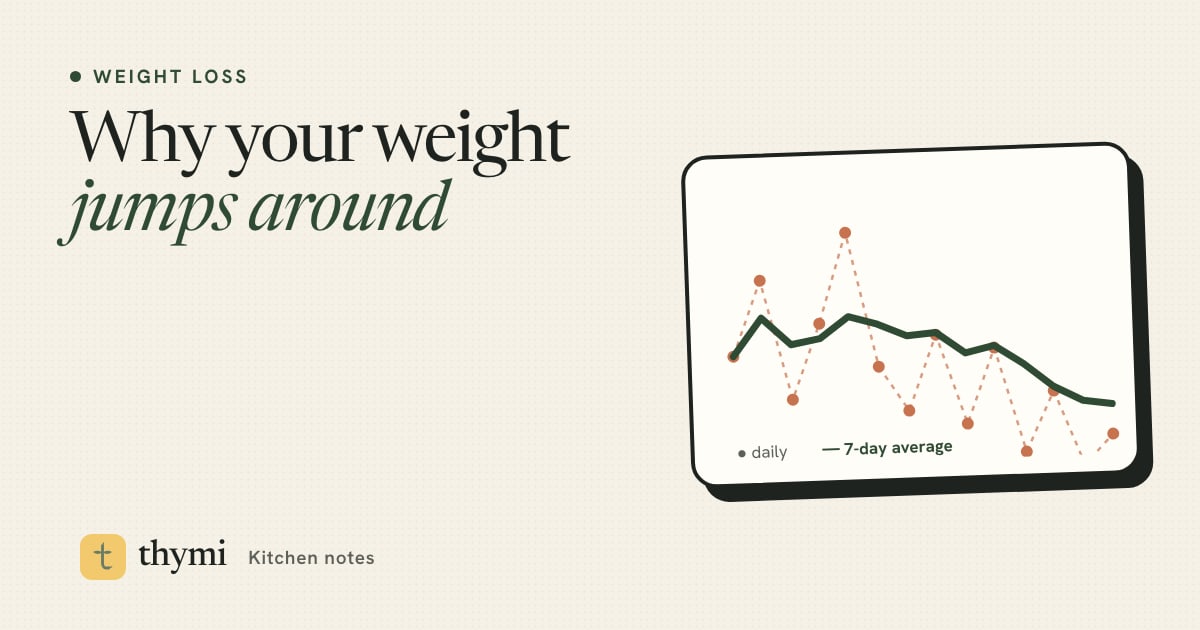
Your weight fluctuates day to day mainly because of changes in water and the contents of your gut, not body fat. Salt, carbohydrates, meal size, bowel movements, hormones, sleep and new exercise can all move the scale overnight, so the most reliable picture comes from weighing consistently and following a 7-day average trend.
How much does weight normally fluctuate?
Your body weight is the combined weight of everything in you at that moment: muscle, fat, bone and organs, but also water, the food and drink you've had recently and whatever is still working its way through your digestive system. Fat and muscle change slowly. Water and gut contents can change by a noticeable amount overnight.
That is why it's common to see your weight move by around half a kilogram to a kilogram or more (roughly 1–2 lb or more) from one morning to the next, with no real change in body fat. Larger bodies, and anyone whose eating, training or routine changes a lot from day to day, may see bigger swings.
A simple way to picture it: if you drink a large glass of water and step on the scale, you'll weigh a little more. Nobody would call that fat gain. Most daily fluctuations are the same thing in slower motion, as water and food come and go over hours and days.
Fat changes, by contrast, are gradual. Because a kilogram of body fat stores a lot of energy, gaining or losing one takes a sustained calorie surplus or deficit over many days, not a single meal. That's why a jump after one big dinner is almost always mostly water and food, not fat. If you want to understand the energy side, see our guide to how big a calorie deficit should be.
Think of a single weigh-in as one noisy data point. It tells you something, but not much on its own. The useful signal is the direction your weight takes over weeks.
Water and sodium
Water makes up a large share of your body weight, and your body adjusts how much it holds all the time. One of the biggest everyday influences is sodium (salt).
After a salty meal, such as a takeaway, a restaurant dinner or a lot of processed snacks, your body tends to hold on to more water to keep its sodium concentration in balance. The next morning the scale can be noticeably higher. As your sodium intake returns to normal over the following day or two, the extra water usually goes with it.
The same works in reverse. How much you drank, how much you sweated and the temperature can all shift your water balance from day to day. None of this is fat gain or fat loss.
Tip: If you see a sudden jump the morning after a restaurant meal, check your diary. A salty, carb-heavy dinner is one of the most common explanations, and it usually settles within a few days. Our guide to tracking calories when eating out has more on handling those meals.
Carbohydrates and glycogen
Your body stores some carbohydrate as glycogen, mainly in your muscles and liver. Each gram of glycogen is stored with roughly 3 grams of water. So when your glycogen stores fill up or empty out, your weight moves by noticeably more than the glycogen itself.
This explains a few patterns people often notice:
- A higher-carb day (pasta night, a celebration, a weekend away) is often followed by a higher weigh-in, as glycogen and its water are topped up.
- Cutting carbs sharply often produces a fast early drop on the scale. Much of that first drop is glycogen and water rather than fat.
- Going back to your usual carbs after a low-carb stretch brings some of that water weight back. That's expected and isn't fat regain.
None of this makes carbohydrates good or bad. It simply means the scale reacts to them in a way that can look dramatic in the short term.
Food volume and digestion
Food and drink have weight before your body does anything with them. A large dinner, a big salad or a litre of water all show up on the scale until they are digested, absorbed and eventually passed.
- Meal size and timing. A large or late meal is more likely to still be in your system when you weigh in the next morning.
- Fibre-rich foods. Vegetables, beans and whole grains are bulky and hold water as they move through your gut. That's a good thing for your health, but it can add temporary weight.
- Bowel movements. Whether or not you've had a bowel movement before weighing can make a visible difference. Constipation can keep the number up for a few days.
Hormones, sleep and exercise
The menstrual cycle
Many people who menstruate notice that their weight rises in the days before a period, often along with bloating, then falls again afterwards. Hormonal changes across the cycle affect water retention and sometimes digestion. If this applies to you, comparing a weigh-in with the same point in your previous cycle can be more useful than comparing it with last week.
Sleep and stress
A short or disrupted night, travel and stressful stretches can all shift water balance, digestion and appetite. If your weight looks odd after a rough week, it's worth taking that into account before drawing conclusions.
New or harder exercise
Starting a new training plan, or a much harder session than usual, often leaves you sore. As your muscles repair, they tend to hold extra water for a while. It's common for the scale to rise slightly in the first week or two of a new routine, even though the training is doing you good.
Good to know: Normal day-to-day swings come and go. A rapid, unexplained gain, especially with swelling in your legs, ankles or tummy or shortness of breath, is different. Talk to a doctor promptly if that happens.
How to weigh yourself consistently
You can't stop your weight from fluctuating, but you can stop your routine from adding extra noise. Consistency matters more than the exact method you choose.
- Same time of day. First thing in the morning works well for most people, because it's easy to repeat.
- Same conditions. After using the toilet and before eating or drinking, in the same clothing (or none).
- Same scale, same spot. Bathroom scales can read differently on carpet or uneven floors. Keep it on a hard, level surface.
- Log every reading. Don't skip the high ones. The highs are part of the average, and leaving them out makes your trend look better than it is.
- Weigh often enough to average. Daily weighing gives you more data for a smooth trend. If daily weighing feels stressful, a few times a week is fine. What matters is that you look at the trend, not single days.
Use a 7-day average to see your trend weight
The simplest way to cut through the noise is a moving average. A 7-day average adds up your last seven weigh-ins and divides by seven. Each day, the oldest reading drops off and the newest is added. Because the highs and lows partly cancel out, the average moves far more smoothly than the raw numbers.
Here's a made-up, purely illustrative example over two weeks. The daily readings bounce around, but the 7-day average shows a slow, steady downward trend.
| Day | Scale (kg) | Scale (lb) | 7-day avg (kg) | 7-day avg (lb) |
|---|---|---|---|---|
| 1 | 80.4 | 177.3 | – | – |
| 2 | 80.9 | 178.4 | – | – |
| 3 | 80.1 | 176.6 | – | – |
| 4 | 79.8 | 175.9 | – | – |
| 5 | 80.6 | 177.7 | – | – |
| 6 | 80.2 | 176.8 | – | – |
| 7 | 79.9 | 176.1 | 80.3 | 177.0 |
| 8 | 79.6 | 175.5 | 80.2 | 176.7 |
| 9 | 80.3 | 177.0 | 80.1 | 176.5 |
| 10 | 79.5 | 175.3 | 80.0 | 176.3 |
| 11 | 79.4 | 175.0 | 79.9 | 176.2 |
| 12 | 80.0 | 176.4 | 79.8 | 176.0 |
| 13 | 79.2 | 174.6 | 79.7 | 175.7 |
| 14 | 79.3 | 174.8 | 79.6 | 175.5 |
Look at day 9. The scale jumped 0.7 kg (about 1.5 lb) overnight, which could feel discouraging. But the 7-day average still went down, from 80.2 to 80.1 kg. The same thing happens on day 12. Meanwhile, the biggest single-day "losses" in the table (day 9 to day 10, and day 12 to day 13) are just as much noise as the jumps were. Neither the good days nor the bad days mean much on their own.
To work out the first average, add days 1 to 7 (80.4 + 80.9 + 80.1 + 79.8 + 80.6 + 80.2 + 79.9 = 561.9) and divide by 7, which gives about 80.3 kg. For day 8, drop day 1, add day 8 and divide by 7 again.
Over the two weeks, the raw readings ranged from 79.2 to 80.9 kg, a spread of 1.7 kg (about 3.7 lb). The average moved smoothly from 80.3 to 79.6 kg. That smooth line is your trend weight, and it's a far better guide to what's happening with your body.
Making sense of your trend
Once you're watching the average rather than the daily number, a few rules of thumb help:
- Judge progress over two to four weeks, not a few days. Short stretches are still affected by water and digestion.
- Expect stalls and whooshes. Sometimes the trend flattens for a week and then drops. Water shifts can mask fat loss for a while.
- Compare like with like. If you menstruate, compare the same phase of your cycle month to month.
- Pair the scale with other signals. How your clothes fit, your energy and your training are useful alongside the number.
- Look at your intake if the trend is flat for several weeks. Our guide to weight loss plateaus covers what to check, and if you're unsure your calorie target is right, see how many calories you should eat a day.
You don't need a spreadsheet for any of this. Thymi's weight log draws a smoothed trend line through your weigh-ins so the daily ups and downs don't dominate, and can import your weight from Apple Health if you use a smart scale. Whatever tool you use, the principle is the same: weigh consistently, log every reading, and trust the trend more than any single day.
Frequently asked questions
Is it normal for weight to fluctuate 1 to 2 kg (2 to 4 lb) a day?
For many people, yes. Changes in water, salt intake, carbohydrates, food still in the gut and bowel movements can move the scale by a kilogram or more between mornings without any change in body fat. If you have a sudden unexplained gain with swelling or shortness of breath, speak to a doctor.
Why do I weigh more after a cheat meal or eating out?
A large, salty or carb-heavy meal makes your body hold extra water, and the food itself is still in your digestive system the next morning. Most of that increase is temporary and fades over a few days as your eating returns to normal.
What is the best time to weigh yourself?
Most people find first thing in the morning easiest, after using the toilet and before eating or drinking, in similar clothing each time. The exact time matters less than doing it the same way each time.
Should I weigh myself every day?
Daily weighing gives you more data points for a smooth average, but it only helps if you focus on the trend rather than each reading. If daily weighing makes you anxious, weighing a few times a week and comparing weekly averages works too.
What is trend weight?
Trend weight is a smoothed version of your daily weigh-ins, such as a 7-day moving average. It reduces the effect of day-to-day water and digestion changes, so it shows the real direction your weight is moving more clearly than any single reading.
Why does my weight go up when I start exercising?
New or harder exercise often causes muscle soreness, and muscles hold extra water while they repair. Your glycogen stores may also increase. This can raise the scale slightly for a week or two and is usually temporary.
This article is general information for healthy adults, not medical or nutritional advice. Talk to a doctor or registered dietitian before changing how you eat, especially if you are pregnant or breastfeeding, have or have had an eating disorder, have a medical condition, or take medication.