Basics
How Many Calories Should I Eat a Day?
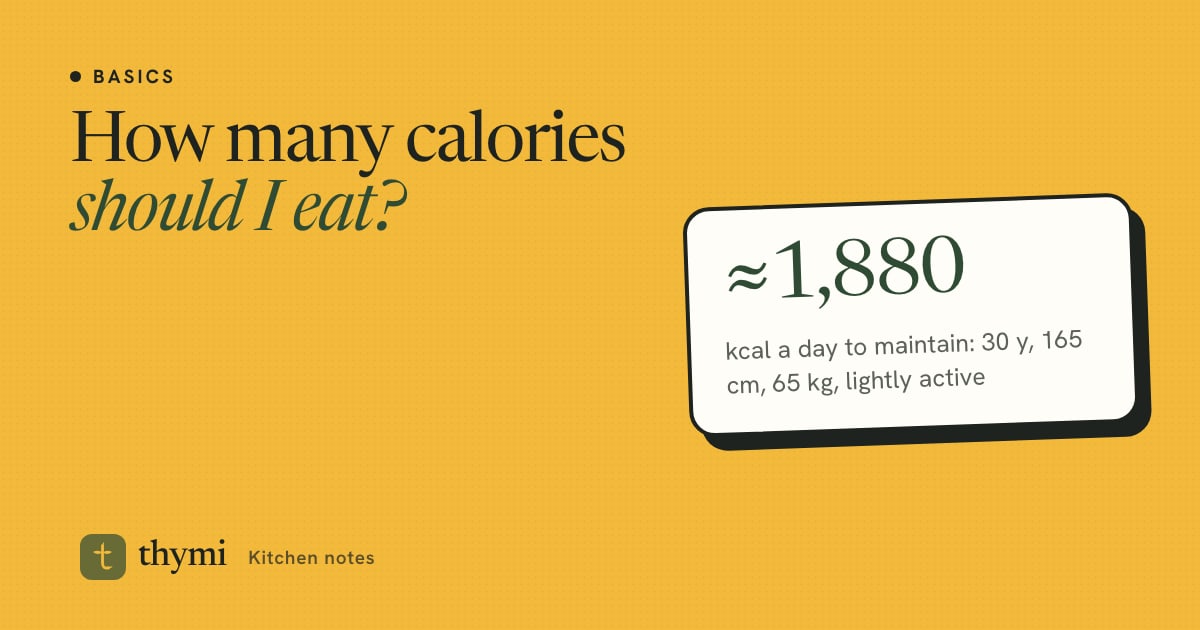
Most adults need somewhere between about 1,600 and 3,000 calories a day, depending on sex, age, body size and how active they are. To find your own number, estimate your resting needs with the Mifflin-St Jeor equation, multiply by an activity factor to get your maintenance calories, then subtract around 300 to 500 calories a day if you want to lose weight.
The short answer: it depends on you
There is no single correct number of calories for everyone. A tall, active 25-year-old man and a shorter, mostly desk-bound 60-year-old woman can have daily needs that differ by well over 1,000 calories.
The Dietary Guidelines for Americans give broad estimates of roughly 1,600 to 2,400 calories a day for adult women and 2,000 to 3,000 for adult men, with lower numbers for less active and older people and higher numbers for younger and more active people. Those ranges are a useful sanity check, but you can get a much more personal estimate in about five minutes.
The process has three steps:
- Estimate your basal metabolic rate (BMR), the energy your body uses at rest.
- Multiply by an activity factor to estimate your total daily energy expenditure (TDEE), also called maintenance calories.
- Adjust for your goal: eat about your TDEE to maintain, a bit less to lose weight, a bit more to gain.
What changes your daily calorie needs
- Body size. A heavier or taller body uses more energy, both at rest and when moving. This is why needs fall slightly as you lose weight.
- Sex. Men tend to need more than women of the same age and size, largely because they typically carry more muscle.
- Age. Energy needs tend to decline gradually with age, partly because many people become less active and lose some muscle.
- Activity. Planned exercise counts, but so does everything else: walking, standing, housework, a physical job. Two people with identical gym routines can burn very different amounts if one has a desk job and the other is on their feet all day.
- Life stage and health. Pregnancy, breastfeeding, illness, recovery from injury and some medications all change energy needs. These are situations to discuss with a professional rather than a calculator.
Why "2,000 calories a day" is not your target
You have probably seen "2,000 calories a day" on food labels. In the US, that figure is a reference value the FDA uses so the Percent Daily Value column means the same thing on every product. It is a round number for comparing foods, not a personal recommendation.
Some people will maintain their weight on 2,000 calories. Many will not. Using it as a target without checking can leave a smaller, less active person slowly gaining weight, or a larger, very active person hungry and losing weight faster than they meant to.
Step 1: Estimate your BMR with Mifflin-St Jeor
Your BMR is the energy your body uses just to keep running: breathing, circulation, keeping warm, repairing cells. For most people it is the largest part of daily energy use. The Mifflin-St Jeor equation is the formula most calculators use to estimate it:
- Men: BMR = (10 × weight in kg) + (6.25 × height in cm) − (5 × age in years) + 5
- Women: BMR = (10 × weight in kg) + (6.25 × height in cm) − (5 × age in years) − 161
If you use pounds and inches, convert first: kilograms = pounds ÷ 2.205, and centimetres = inches × 2.54. For example, someone who weighs 180 lb and is 5 ft 8 in (68 inches) tall would use 180 ÷ 2.205 = about 81.6 kg and 68 × 2.54 = about 172.7 cm.
The equation does not know how much muscle you carry, so very muscular people may need a bit more than it predicts, and it is less reliable for people at the extremes of body size. It is still the most widely used starting point for healthy adults.
For a deeper look at the difference between BMR and total burn, see what TDEE is and how it is calculated.
Step 2: Multiply by your activity level
Next, multiply your BMR by the activity factor that best describes a typical week. This turns your resting estimate into maintenance calories.
| Activity level | What it looks like | Multiply BMR by |
|---|---|---|
| Sedentary | Desk job, little or no planned exercise | 1.2 |
| Lightly active | Light exercise or sport 1 to 3 days a week | 1.375 |
| Moderately active | Moderate exercise 3 to 5 days a week | 1.55 |
| Very active | Hard exercise 6 to 7 days a week | 1.725 |
| Extra active | Very hard training or a physical job plus exercise | 1.9 |
Tip: when in doubt, choose the lower level. Most people overestimate how active they are, and it is easier to add calories later than to wonder why progress has stalled.
Step 3: Adjust for your goal
Your TDEE is your estimated maintenance intake. From there:
- To maintain weight: eat around your TDEE.
- To lose weight: eat below your TDEE. A deficit of about 500 calories a day is a common starting point. Using the classic approximation that 3,500 calories is roughly one pound of body fat, that works out to about 0.5 kg (1 lb) a week. A smaller deficit of 250 to 300 calories is slower but often easier to sustain.
- To gain weight: eat slightly above your TDEE, for example 250 to 500 calories more, especially alongside strength training.
The NHS and US health guidance commonly describe losing around 0.5 to 1 kg (1 to 2 lb) a week as a safe pace for most adults. Faster is not better if it leaves you exhausted and hungry. Our guide to how big a calorie deficit should be goes into the trade-offs.
Worked examples
Example 1: Maya, 35, lightly active
Maya is 165 cm (5 ft 5 in) tall, weighs 70 kg (154 lb) and does yoga and brisk walks two or three times a week.
- BMR = (10 × 70) + (6.25 × 165) − (5 × 35) − 161 = 700 + 1,031 − 175 − 161 = about 1,395 calories
- TDEE = 1,395 × 1.375 = about 1,920 calories
- To lose about 0.5 kg (1 lb) a week: 1,920 − 500 = about 1,420 calories a day
Example 2: James, 40, moderately active
James is 180 cm (5 ft 11 in) tall, weighs 90 kg (198 lb) and goes to the gym or plays football four times a week.
- BMR = (10 × 90) + (6.25 × 180) − (5 × 40) + 5 = 900 + 1,125 − 200 + 5 = 1,830 calories
- TDEE = 1,830 × 1.55 = about 2,840 calories
- To lose about 0.5 kg (1 lb) a week: 2,840 − 500 = about 2,340 calories a day
Notice how different the numbers are. Both of these are reasonable weight-loss targets, yet James's is more than Maya's maintenance level. That is exactly why a generic number does not work.
| Person | BMR | Maintenance (TDEE) | Weight-loss target |
|---|---|---|---|
| Maya, 35, 70 kg (154 lb), lightly active | ~1,395 | ~1,920 | ~1,420 |
| James, 40, 90 kg (198 lb), moderately active | 1,830 | ~2,840 | ~2,340 |
How low is too low?
Cutting calories further does not keep making things better. Very large deficits are harder to stick to, make it more difficult to get enough protein, fibre, vitamins and minerals, and can leave you tired, irritable and preoccupied with food.
Commonly cited floors are around 1,200 calories a day for women and 1,500 for men. Going below these should only happen under medical supervision. These are floors, not goals: many people will feel and do better well above them.
Good to know: calorie calculators are designed for healthy adults. If you are pregnant or breastfeeding, under 18, managing a medical condition, taking medication that affects appetite or weight, or have a history of disordered eating, ask a doctor or registered dietitian to help you set a target.
Test your number and adjust it
Every calculator, including the equations above, gives an estimate. Your real needs may be a couple of hundred calories higher or lower. The way to find out is to eat close to your target consistently and watch what happens.
- Track your intake for two to four weeks. Our guide on how to count calories covers the basics.
- Weigh yourself a few times a week under similar conditions and look at the average trend, not individual days.
- Compare. If you are losing weight faster than about 1 kg (2 lb) a week after the first couple of weeks, eat a little more. If your trend has not moved at all, reduce by 100 to 200 calories, or double-check your logging first.
Expect a bigger drop in the first week or two of a deficit. Part of that is water and stored carbohydrate (glycogen), not fat, so judge your pace on the weeks that follow. Recalculate every 4 to 5 kg (roughly 10 lb) of weight change, since a smaller body needs slightly less energy.
Beyond calories: protein, fibre and food quality
Two people can eat the same calories and feel very different. A few reference points help:
- Protein: the adult RDA is 0.8 g per kg of body weight a day (about 56 g for a 70 kg / 154 lb person). Many people aim higher while losing weight to help keep muscle and stay full. See how much protein you need a day.
- Fibre: a common guideline is about 14 g per 1,000 calories, so around 25 to 30 g on a typical intake. Vegetables, fruit, beans, lentils and whole grains help you get there.
- Mostly whole foods: foods that are less processed tend to be more filling for their calories, which makes any target easier to live with.
If you would rather not do the maths by hand, Thymi calculates a daily calorie target and protein, carb, fat and fibre targets from your body, activity, goal and pace, using a Mifflin-St Jeor based formula. You can adjust any of them, and the weight trend line shows whether the number is working for you.
Frequently asked questions
How many calories should I eat a day to lose weight?
Start by estimating your maintenance calories (TDEE) from your BMR and activity level, then subtract about 300 to 500 calories a day. By the common 3,500-calories-per-pound approximation, a 500 calorie daily deficit works out to roughly 0.5 kg (1 lb) a week. Check your weight trend after two to four weeks and adjust.
Is 1,200 calories a day enough?
For most adults, 1,200 calories is at or below the minimum commonly recommended without medical supervision, which is around 1,200 calories for women and 1,500 for men. Many people need considerably more. If you think you need to eat this little, speak to a doctor or registered dietitian first.
Is 2,000 calories a day a good target?
2,000 calories is a reference value used on US nutrition labels to make the Percent Daily Value consistent, not a personal recommendation. Your own needs depend on your sex, age, height, weight and activity, and could be well above or below 2,000.
How accurate are calorie calculators?
Equations like Mifflin-St Jeor give a reasonable starting estimate for most healthy adults, but individuals vary. Treat the number as a starting point, track your intake and weight trend for a few weeks, and adjust by 100 to 200 calories if your results do not match the estimate.
Should I eat the same number of calories every day?
Not necessarily. Your weekly average matters more than any single day. Some people prefer the same target daily, while others eat a little less on quieter days and more on active days or weekends. Both can work if the weekly total is where you want it.
Do I need to recalculate my calories as I lose weight?
Yes. A smaller body uses less energy, so your maintenance calories fall as you lose weight. Recalculating every 4 to 5 kg (about 10 lb) of weight change keeps your target realistic.
This article is general information for healthy adults, not medical or nutritional advice. Talk to a doctor or registered dietitian before changing how you eat, especially if you are pregnant or breastfeeding, have or have had an eating disorder, have a medical condition, or take medication.