Macros
How to Count Macros: A Simple Guide for Beginners
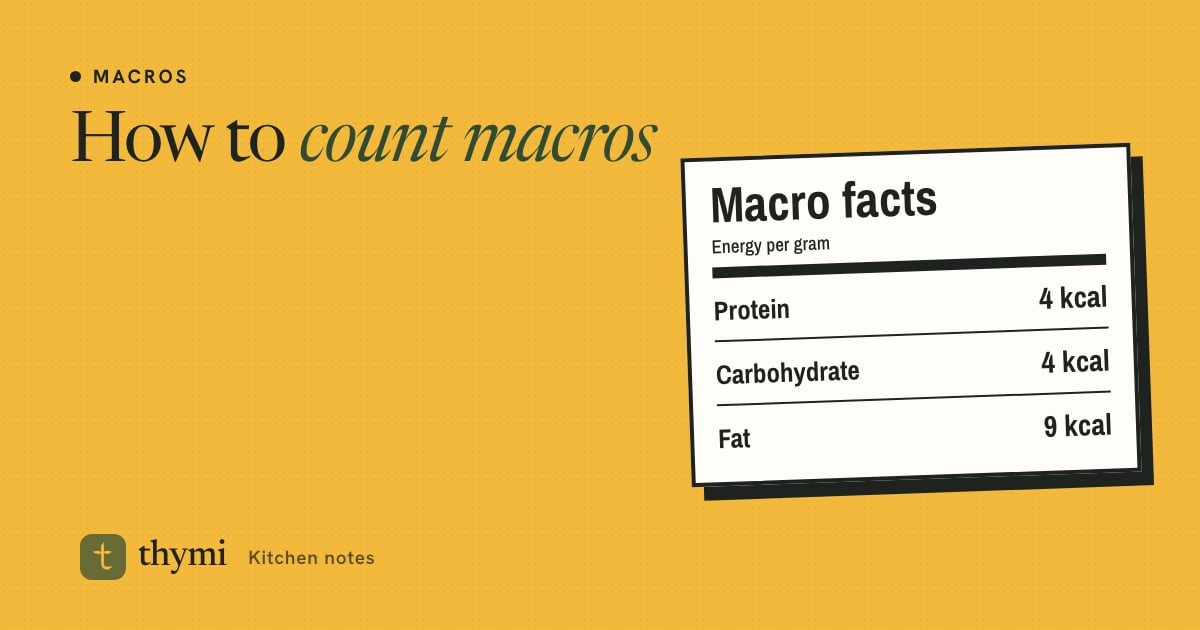
To count macros, set a daily calorie target, split it into grams of protein, carbohydrate and fat, then log what you eat and compare each total with its target. Protein and carbs give about 4 calories per gram and fat about 9, so the maths is simple once your targets are set. Aim to land close most days, not to hit every number exactly.
What macros are (macronutrients explained)
“Macros” is short for macronutrients: the three nutrients your body needs in large amounts and that supply almost all of the energy in food. They are protein, carbohydrate and fat. Alcohol also contains energy, but it is not a nutrient you need, so it is usually tracked separately or folded into your carb or fat numbers.
Each macro has a different job:
- Protein provides the building blocks for muscle, skin, enzymes and many other tissues. It also tends to be the most filling macro per calorie.
- Carbohydrate is the body’s preferred quick fuel, especially for the brain and for harder exercise. Fiber is a type of carbohydrate too.
- Fat supplies essential fatty acids, helps you absorb vitamins A, D, E and K, and is needed for hormone production.
Micronutrients, by contrast, are the vitamins and minerals you need in much smaller amounts. Counting macros does not track those directly, which is one reason food quality still matters.
| Macronutrient | Calories per gram | Common sources |
|---|---|---|
| Protein | 4 | Chicken, fish, eggs, Greek yogurt, tofu, lentils |
| Carbohydrate | 4 | Rice, bread, oats, potatoes, fruit, beans |
| Fat | 9 | Oils, butter, nuts, seeds, cheese, avocado |
| Alcohol (not a macro you need) | 7 | Beer, wine, spirits |
Those four numbers are the whole foundation of macro maths. If a food has 20 g protein, 30 g carbs and 10 g fat, it has roughly (20 × 4) + (30 × 4) + (10 × 9) = 80 + 120 + 90 = 290 calories.
Why count macros instead of just calories?
Calories decide whether your weight trends up, down or stays steady. Macros shape how that feels and what the weight change is made of. Two days with the same 1,800 calories can be very different: one built around protein, vegetables and whole grains, another mostly pastries and soft drinks. The second is usually far less filling.
Tracking macros helps with a few practical things:
- Getting enough protein, which helps you hold on to muscle while losing weight and keeps meals satisfying.
- Fuelling training, by making sure there are enough carbs around workouts.
- Spotting patterns, such as most of your calories coming from fat-heavy snacks you barely notice.
That said, macro counting is optional. If you are new to tracking, it is perfectly reasonable to start with calories and protein only, then add carbs and fat later. Our guide on how to count calories covers that simpler starting point.
Step 1: Set your daily calorie target
Macros sit inside a calorie budget, so start there. Your calorie needs depend on your body size, age, sex, how active you are and whether you want to lose, maintain or gain weight. The usual approach is to estimate your total daily energy expenditure (TDEE), then adjust it for your goal.
- Maintain: eat around your estimated TDEE.
- Lose: eat moderately below it. A modest deficit is easier to sustain and protects energy levels.
- Gain: eat slightly above it, ideally alongside strength training.
Any formula gives an estimate, not a measurement. Treat the first number as a starting point and adjust after two or three weeks based on your actual weight trend. For the details, see how many calories you should eat a day and how total daily energy expenditure (TDEE) is estimated.
Step 2: Choose your protein, fat and carb targets
There is no single “correct” macro split. A sensible framework is the US Acceptable Macronutrient Distribution Ranges (AMDR), which give broad healthy ranges for adults:
| Macronutrient | Share of daily calories (AMDR) |
|---|---|
| Carbohydrate | 45–65% |
| Fat | 20–35% |
| Protein | 10–35% |
Within those ranges, the easiest beginner method is to set targets in this order:
1. Protein first, based on body weight
The adult RDA for protein is 0.8 g per kilogram of body weight, which is the minimum to cover basic needs. Many people who are active or trying to lose weight use a higher range of roughly 1.2–2.0 g per kg. A middle value such as 1.6 g/kg is a common, practical choice. Read how much protein you need a day for more on choosing a number.
2. Fat as a percentage of calories
Setting fat at around 25–30% of calories keeps you comfortably within the AMDR and leaves room for oils, nuts, dairy and the fat that naturally comes with protein foods.
3. Carbs fill the rest
Whatever calories remain after protein and fat go to carbohydrates. This keeps the maths simple and means your carb target automatically adjusts if you change calories.
Good to know: If you have kidney disease, diabetes or another medical condition, ask your doctor or a registered dietitian before raising protein or changing your carbohydrate intake.
Worked example: macros for a 2,000-calorie day
Let’s use a person who weighs 70 kg (154 lb), is moderately active, and has settled on a target of 2,000 calories a day.
- Protein: 70 kg × 1.6 g = 112 g. That is 112 × 4 = 448 calories.
- Fat: 30% of 2,000 = 600 calories. 600 ÷ 9 ≈ 67 g.
- Carbs: 2,000 − 448 − 600 = 952 calories. 952 ÷ 4 = 238 g.
| Macro | Grams | Calories | % of total |
|---|---|---|---|
| Protein | 112 g | 448 | ≈ 22% |
| Fat | 67 g | 600 | 30% |
| Carbohydrate | 238 g | 952 | ≈ 48% |
| Total | 2,000 | 100% |
Every number lands inside the AMDR. If this person preferred fewer carbs, they could move fat to 35% (about 78 g) and carbs would drop to about 213 g. Both are reasonable; pick the one that suits how you like to eat.
A useful extra target is fiber. A common guideline is about 14 g of fiber per 1,000 calories, so roughly 28 g on a 2,000-calorie day. Our guide to daily fiber has easy ways to get there.
Tip: Most online macro calculators follow these same steps. Running the maths yourself once helps you understand where the numbers come from, so you can adjust them with confidence.
Step 3: Log your food and read the numbers
Once targets are set, counting macros is just logging food accurately. The grams of protein, carbs and fat come from a nutrition label or a food database such as USDA FoodData Central.
Here is how a simple lunch adds up, using approximate values:
| Food (portion) | kcal | Protein | Carbs | Fat |
|---|---|---|---|---|
| Chicken breast, cooked (100 g / 3.5 oz) | ≈ 165 | ≈ 31 g | 0 g | ≈ 4 g |
| White rice, cooked (1 cup) | ≈ 205 | ≈ 4 g | ≈ 45 g | ≈ 0 g |
| Olive oil (1 tbsp) | ≈ 120 | 0 g | 0 g | ≈ 14 g |
| Lunch total | ≈ 490 | ≈ 35 g | ≈ 45 g | ≈ 18 g |
Notice the tablespoon of oil: it adds almost as many calories as the chicken but no protein. Cooking fats, dressings and sauces are the most common things beginners forget to log, and they mostly count toward fat.
Tips for accurate logging
- Weigh or measure for the first week or two. It trains your eye. After that, estimating is usually fine. See how to estimate portions without a scale.
- Check raw versus cooked. Rice, pasta and meat change weight when cooked, so match the database entry to what you weighed.
- Log as you go. Recording a meal straight after eating is far more accurate than reconstructing the day at night.
- Use the label for packaged food. Check the serving size first, since every number on the label refers to it.
Step 4: Hit your targets without stress
You will rarely hit every macro exactly, and you do not need to. A practical aim is to land within about 5–10 g of your protein target and keep calories near your goal, letting carbs and fat flex a little day to day. Looking at your weekly average is more meaningful than any single day.
Some habits that make it easier:
- Build each meal around a protein source. Splitting 112 g over three meals and a snack means roughly 25–35 g per meal, which is much easier than catching up at dinner.
- Plan the day’s anchor meals first. Log breakfast and dinner in advance, then use lunch and snacks to fill the gaps.
- Keep a few “macro-friendly” staples on hand. Greek yogurt, eggs, tinned tuna, lentils, oats and frozen vegetables make adjustments simple.
- Swap rather than cut. If fat is running high, change cooking oil to a spray or swap a creamy sauce for a tomato one, rather than skipping a meal.
Common macro-counting mistakes
- Chasing perfect numbers. Food databases and labels are estimates, so precision past a few grams is false accuracy.
- Forgetting drinks. Milk in coffee, juice, smoothies and alcohol all add up. Alcohol adds 7 calories per gram on top of any carbs.
- Setting protein too high to reach. If you consistently miss by 40 g, lower the target to something achievable and build up gradually.
- Ignoring hunger and energy. If you are always hungry or tired, your calorie target or macro balance may need adjusting.
- Changing too many things at once. Give a new set of targets two to three weeks before judging it, since daily scale weight naturally bounces around.
How an app makes macro counting easier
Doing macro maths by hand works, but it is slow. A tracking app handles the arithmetic so you can focus on choices. In Thymi, your calorie target and protein, carb, fat and fiber targets are calculated from your body, activity, goal and pace, and you can adjust any of them. As you log a meal, by photo, barcode, nutrition-label photo, a typed description like “two eggs on toast” or search, the gauges for each macro fill up, so you can see at a glance what is left for the day.
Whatever tool you use, the steps are the same: set a calorie target, choose protein first, set fat, let carbs fill the rest, then log consistently and adjust based on how you feel and how your weight trends.
Frequently asked questions
What is the easiest way to count macros for beginners?
Start with a calorie target and a protein target only. Log everything you eat for a week or two using a nutrition label or food database, and once that feels routine, add fat and carb targets. Setting protein first, fat at about 25–30% of calories and carbs as the remainder keeps the maths simple.
How do I calculate my macros?
Estimate your daily calories, then set protein by body weight (for example 1.6 g per kg), set fat as a percentage of calories (for example 30%), and give the remaining calories to carbs. Convert calories to grams by dividing by 4 for protein and carbs and by 9 for fat.
What is a good macro ratio for weight loss?
There is no single best ratio. Calories matter most for weight loss, and many people find a higher protein intake helps them stay full and keep muscle. A split that stays within the AMDR, such as roughly 25% protein, 30% fat and 45% carbs, is a reasonable starting point to adjust from.
Do I have to hit my macros exactly every day?
No. Food labels and databases are estimates, so being within a few grams is as precise as tracking can be. Aim to land close to your protein and calorie targets most days and look at weekly averages rather than any single day.
Is counting macros better than counting calories?
Neither is better for everyone. Calorie counting is simpler and drives weight change. Macro counting adds detail about what those calories are made of, which can help with fullness, training and protein intake. Many people track calories plus protein as a middle ground.
Does alcohol count toward my macros?
Alcohol provides about 7 calories per gram but is not a macronutrient you need. Most people count it toward their calorie total, and many apps and labels fold its calories into carbs or fat. The key is to log it so your calorie total stays accurate.
This article is general information for healthy adults, not medical or nutritional advice. Talk to a doctor or registered dietitian before changing how you eat, especially if you are pregnant or breastfeeding, have or have had an eating disorder, have a medical condition, or take medication.