Nutrition
How Much Fiber Per Day? Targets and Easy Ways to Get There
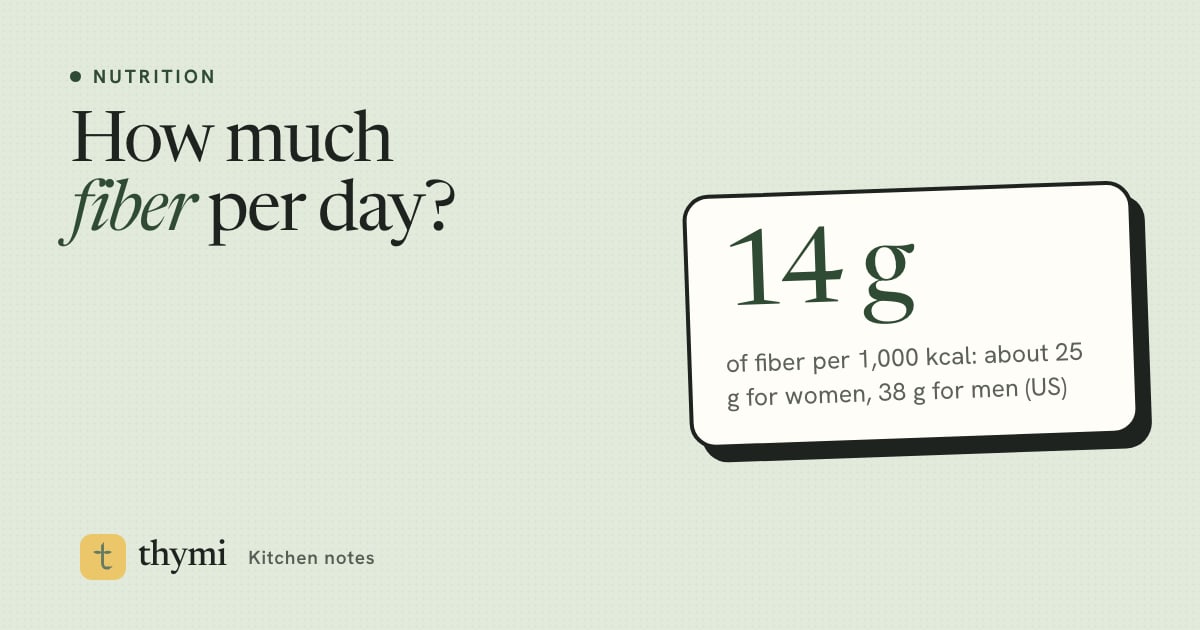
Most adults should aim for about 25–38 g of fiber per day. US guidance works out to about 14 g per 1,000 calories, roughly 25 g a day for women and 38 g for men aged 19–50, while the UK recommends 30 g a day for adults. Most people eat well below this, so the goal for most of us is to add fiber gradually, with plenty of water.
What fiber is and why it matters
Dietary fiber (or fibre, in UK spelling) is the part of plant foods your body cannot fully digest. Instead of being broken down and absorbed in the small intestine like most carbohydrate, it travels to the large intestine, where some of it is fermented by gut bacteria and the rest adds bulk.
You will find it only in plant foods: whole grains, beans and lentils, vegetables, fruit, nuts and seeds. Meat, fish, eggs and dairy contain essentially none.
Diets rich in fiber are widely recommended by health bodies such as the NHS and the US Dietary Guidelines. Getting enough helps keep bowel movements regular and comfortable, and fiber-rich foods are linked with better heart health and blood sugar control. Fiber-rich foods also tend to be filling, which is useful whatever your weight goal.
Soluble and insoluble fiber
Fiber is often split into two broad types. Most plant foods contain a mix of both.
- Soluble fiber absorbs water and forms a gel. It is found in oats, barley, beans, lentils, apples, citrus fruit and psyllium.
- Insoluble fiber does not dissolve and adds bulk, helping things move through your gut. It is found in wheat bran, whole-grain bread, nuts, seeds and the skins of fruit and vegetables.
You do not need to track the two separately. Eating a variety of plant foods covers both.
How much fiber per day: official targets
There are two common ways to set a daily fiber target, and they land in a similar place.
US guidance: about 14 g per 1,000 calories
The US Dietary Reference Intakes base fiber on energy intake: about 14 g for every 1,000 calories you eat. On a 2,000-calorie day that is 28 g, which is also the Daily Value used on US nutrition labels. Translated into fixed amounts for adults:
| Group (US guidance) | Fiber per day |
|---|---|
| Women, 19–50 | 25 g |
| Men, 19–50 | 38 g |
| Women, 51 and over | 21 g |
| Men, 51 and over | 30 g |
UK guidance: 30 g a day
In the UK, the NHS recommends that adults aim for 30 g of fiber a day, regardless of sex. Children need less, with targets that rise with age.
Which should you use?
Either is a sensible target. If you track calories, 14 g per 1,000 calories scales neatly with your intake. If you prefer one simple number, 30 g is easy to remember. If you currently eat far less, any steady increase toward these numbers is progress.
Good to know: If you have a digestive condition such as IBS, inflammatory bowel disease, or have had bowel surgery, the right type and amount of fiber can be different for you. Ask your doctor or dietitian before making big changes.
High fiber foods: how much they contain
Here is roughly how much fiber you get from common foods. Values are approximate and vary with variety, ripeness and cooking, so use labels for packaged foods.
| Food (portion) | Fiber | Calories |
|---|---|---|
| Lentils, cooked (1 cup) | ≈ 15 g | ≈ 230 |
| Black beans, cooked (1 cup) | ≈ 15 g | ≈ 225 |
| Chickpeas, cooked (1 cup) | ≈ 12 g | ≈ 270 |
| Chia seeds (1 oz / 28 g) | ≈ 10 g | ≈ 140 |
| Green peas, cooked from frozen (1 cup) | ≈ 9 g | ≈ 125 |
| Raspberries (1 cup) | ≈ 8 g | ≈ 65 |
| Pear (1 medium, with skin) | ≈ 5.5 g | ≈ 100 |
| Broccoli, cooked (1 cup chopped) | ≈ 5 g | ≈ 55 |
| Apple (1 medium, with skin) | ≈ 4 g | ≈ 95 |
| Oats, cooked (1 cup) | ≈ 4 g | ≈ 165 |
| Baked potato with skin (1 medium) | ≈ 4 g | ≈ 160 |
| Almonds (1 oz / 28 g) | ≈ 3.5 g | ≈ 165 |
| Brown rice, cooked (1 cup) | ≈ 3.5 g | ≈ 220 |
| Banana (1 medium) | ≈ 3 g | ≈ 105 |
The standouts are pulses. A single cup of lentils or beans provides more than half of a 25 g target, plus a good amount of protein. If you only make one change, adding beans or lentils to a few meals a week is a strong one.
What 30 g of fiber looks like in a day
Thirty grams can sound like a lot, but it adds up quickly when each meal includes one or two fiber-rich foods. Here is an example using approximate values:
| Meal | Food | Fiber (approx.) |
|---|---|---|
| Breakfast | 1 cup cooked oats with ½ cup raspberries | ≈ 8 g |
| Lunch | Sandwich on 2 slices whole-wheat bread, plus an apple | ≈ 8 g |
| Snack | 1 oz (28 g) almonds | ≈ 3.5 g |
| Dinner | ½ cup cooked lentils in a curry or soup, with 1 cup broccoli | ≈ 12.5 g |
| Day total | ≈ 32 g | |
Compare that with a day of white toast, a ham sandwich on white bread, crisps and pasta with a cream sauce, which could easily come in under 10 g. The calories might be similar; the fiber is not.
Tip: Whole-wheat bread varies a lot by brand. Check the label: many loaves have around 2 g of fiber per slice, while some have more.
Fiber for weight loss
Fiber is not a fat burner, and no single food causes weight loss. Weight change still comes down to calories in versus calories out over time. Where fiber helps is in making a calorie deficit feel more manageable:
- More food for the calories. Vegetables, fruit, beans and whole grains tend to be bulky and lower in energy density, so you can eat a satisfying portion for fewer calories.
- Slower eating. High-fiber foods often take more chewing, which naturally slows meals down.
- Steadier fullness. Soluble fiber slows digestion, which can help meals feel more satisfying.
Pair fiber with protein for the most filling meals. A bowl of lentil soup, a bean chilli, or Greek yogurt with berries and chia seeds all combine both. For the protein side, see how much protein you need a day, and for setting a realistic deficit, read how big a calorie deficit should be.
How to increase your fiber intake without discomfort
The most common mistake is going from 12 g to 35 g overnight. A sudden jump can cause bloating, gas and cramps while your gut adjusts. A gentler approach works better:
- Add a little at a time. Increase by a few grams every few days rather than all at once. For example, add an apple this week and a portion of beans next week.
- Drink plenty of water. Fiber works best with fluid, especially soluble fiber, which absorbs water.
- Spread it out. Including some fiber at each meal is easier on your gut than one very large serving.
- Keep the skins on. Eat potatoes, apples and pears unpeeled where you can.
- Swap, don’t overhaul. White rice to brown, white bread to whole-grain, juice to whole fruit, and crisps to air-popped popcorn or a handful of nuts.
- Lean on convenience. Canned beans (rinsed), frozen peas, frozen berries and microwave grain pouches make it easy.
Mild gas usually settles as your gut gets used to more fiber. If you have ongoing pain, a big change in bowel habits, or anything that worries you, see a doctor.
What about fiber supplements?
Supplements such as psyllium can help some people, but whole foods are the better first choice because they also bring vitamins, minerals and other plant compounds. If you use a supplement, start with a small dose, take it with plenty of water, and check with a pharmacist if you take any medication, since fiber can affect how some medicines are absorbed.
Easy high-fiber ideas for every meal
If tables of numbers are not your thing, think in terms of adding one fiber-rich food to each meal and snack:
- Breakfast: porridge or overnight oats topped with berries, a spoon of chia or ground flaxseed, or whole-grain toast with peanut butter and banana.
- Lunch: add a handful of chickpeas or beans to a salad, choose a lentil or bean soup, or swap a white wrap for a whole-grain one.
- Dinner: fill half your plate with vegetables, stir lentils into a pasta sauce or curry, or serve a potato with its skin on.
- Snacks: a pear or apple, a small handful of nuts, hummus with carrot sticks, or a bowl of air-popped popcorn.
Frozen vegetables and fruit count just as much as fresh and are often cheaper, so they are an easy way to keep fiber on hand all week.
Finding fiber on food labels
On a US Nutrition Facts label, fiber appears as “Dietary Fiber” under Total Carbohydrate, with a % Daily Value based on 28 g. As a rough guide, 5% DV or less per serving is low and 20% DV or more is high. In the UK, fibre may be listed per 100 g and per portion.
Compare breads, cereals and crackers per serving: two products that look similar can differ several-fold in fiber. Our guide on how to read a nutrition facts label walks through the rest of the panel.
Tracking fiber alongside calories
Most people have no idea how much fiber they eat until they look. A few days of tracking is usually enough to see where the gaps are, often breakfast and snacks.
Thymi includes a daily fiber target alongside calories, protein, carbs and fat, calculated from your profile and adjustable if you prefer the UK’s 30 g or another number. The fiber gauge fills as you log, so you can see by mid-afternoon whether to add beans or vegetables to dinner. The same approach works on paper or in any app: track for a week, find your lowest-fiber meal, and upgrade that one first.
Frequently asked questions
How much fiber should I eat per day?
US guidance is about 14 g of fiber per 1,000 calories, which works out to roughly 25 g a day for women and 38 g for men aged 19–50 (21 g and 30 g after 50). The UK recommends 30 g a day for adults. Most people eat less than this and benefit from increasing gradually.
What foods are highest in fiber?
Beans, lentils and chickpeas are among the richest everyday sources, with roughly 12–15 g per cooked cup. Chia seeds, raspberries, green peas, pears, broccoli, whole grains, nuts and potatoes with the skin on are also good sources.
Does fiber help with weight loss?
Fiber does not burn fat, but fiber-rich foods are usually filling and lower in energy density, so they can make eating in a calorie deficit easier. Combining fiber with protein at meals tends to be the most satisfying approach.
Is it bad to eat too much fiber?
Increasing fiber too quickly can cause bloating, gas and discomfort. Very high intakes may be uncomfortable for some people. Increase gradually, drink plenty of water, and speak to a doctor if you have a digestive condition or ongoing symptoms.
How can I get 30 grams of fiber a day?
Include one or two fiber-rich foods at every meal. For example, oats with raspberries at breakfast, a whole-grain sandwich and an apple at lunch, a handful of almonds as a snack, and lentils with broccoli at dinner add up to roughly 30 g.
Should I take a fiber supplement?
Whole foods are the best first choice because they bring other nutrients too. A supplement such as psyllium can help some people. Start small, take it with water, and check with a pharmacist if you take medication, as fiber can affect absorption of some medicines.
This article is general information for healthy adults, not medical or nutritional advice. Talk to a doctor or registered dietitian before changing how you eat, especially if you are pregnant or breastfeeding, have or have had an eating disorder, have a medical condition, or take medication.