Activity
Should You Eat Back Your Exercise Calories?
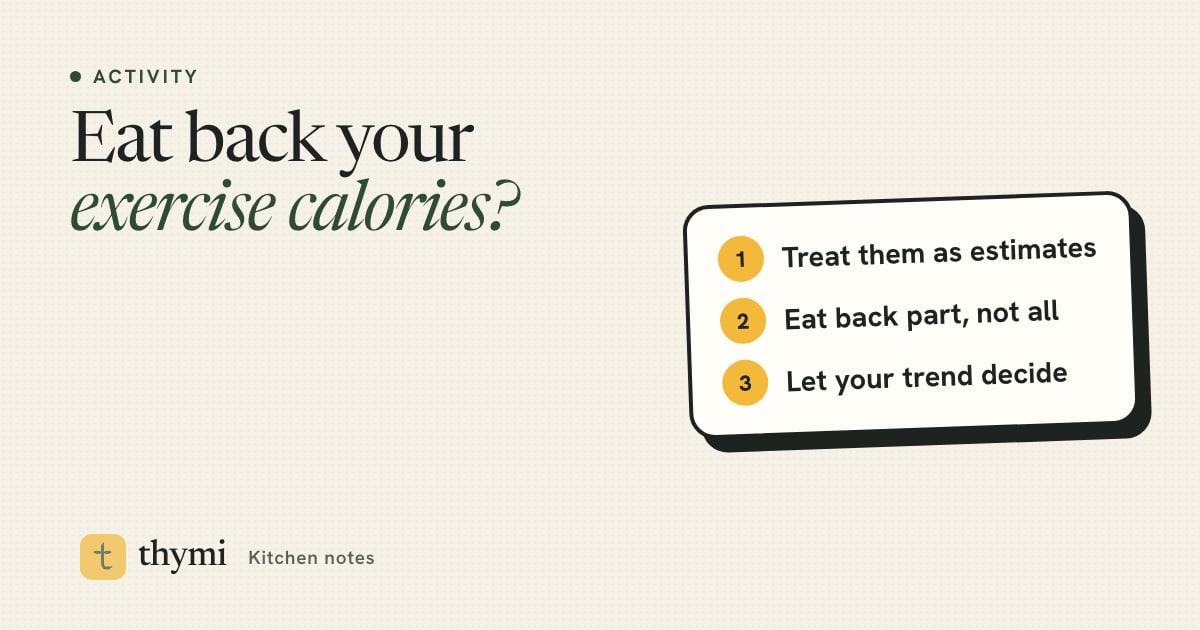
It depends on how your calorie target was set. If your target already accounts for your workouts, do not eat them back, or you will count them twice. If your target assumes little or no exercise, eating back some of them, often about half because calorie-burn estimates can be off, is a sensible starting point, then adjust based on your weight trend over a few weeks.
The short answer
“Eating back” exercise calories means adding the calories a workout burned to your daily food budget. If your target is 1,800 calories and a run burned 300, eating them back would raise today’s budget to 2,100.
Whether that is a good idea comes down to two questions:
- Does your calorie target already include exercise? If you chose an activity level like “moderately active” because you work out several times a week, your target already has those calories built in. Adding them again would double-count them.
- How reliable is your calories-burned number? Watches, apps and gym machines estimate exercise calories; none measures them directly. Estimates can be noticeably too high or too low.
Because of the second point, many people take a middle path: they eat back part of their exercise calories, often around half, and let their weight trend tell them whether to adjust. That is a practical habit, not a rule.
How your calorie target is built (and where exercise fits)
Most calorie targets start with an estimate of your total daily energy expenditure (TDEE): the energy your body uses at rest, plus the energy for digesting food, daily movement and exercise. A common approach multiplies your resting energy by an activity factor, then subtracts a deficit if you want to lose weight. Our guide to TDEE explains the parts in more detail.
There are two common ways exercise is handled:
| How your target was set | What it means for exercise calories |
|---|---|
| Activity level includes your workouts (e.g. “active”) | Exercise is already in the budget. Do not add it again, or add only unusually long or extra sessions. |
| Activity level reflects daily life only (e.g. “sedentary” or “lightly active”) | Exercise is not in the budget. Adding back some or all of it keeps your deficit at the size you planned. |
If you are not sure which applies to you, check how your app or calculator describes its activity levels. If the description mentions exercise sessions per week, your workouts are probably already counted.
How calories burned during exercise are estimated
Most calorie-burn figures come from one of two methods, sometimes both.
METs: the standard formula
A MET (metabolic equivalent of task) compares the energy cost of an activity with sitting at rest. Sitting quietly is 1 MET; an activity of 4 METs uses roughly four times as much energy. The standard estimate is:
Calories ≈ MET × body weight in kg × hours
Approximate MET values from standard activity tables give a sense of scale:
| Activity, 30 minutes | ≈ MET | 70 kg / 154 lb | 90 kg / 198 lb |
|---|---|---|---|
| Yoga (gentle) | 2.5 | ≈ 90 kcal | ≈ 115 kcal |
| Walking, moderate pace (about 3 mph / 5 km/h) | 3.5 | ≈ 120 kcal | ≈ 160 kcal |
| Weight training, moderate | 3.5 | ≈ 120 kcal | ≈ 160 kcal |
| Cycling, moderate effort | 8 | ≈ 280 kcal | ≈ 360 kcal |
| Running, 6 mph / 10 min per mile | ≈ 10 | ≈ 345 kcal | ≈ 440 kcal |
Two things stand out. First, heavier people burn more for the same activity. Second, the figures are gross calories: they include the roughly 1 MET you would have burned anyway just being alive. The extra energy the workout cost is closer to (MET − 1) × kg × hours. For 30 minutes of walking at 70 kg, that is about 90 extra calories rather than 120.
Wearables and gym machines
Fitness trackers and smartwatches estimate energy from heart rate, movement and the details in your profile, such as age, sex, height and weight. Treadmills and bikes typically use speed, incline or power and your entered weight. All of these are models, not measurements, and they can disagree with each other for the same workout.
Are fitness tracker calories accurate?
Wearables are generally better at counting steps and tracking heart rate than at estimating calories. Energy burned depends on factors a wrist sensor cannot see directly, such as your fitness level, efficiency of movement and body composition. Estimates can be off, sometimes by a lot, and accuracy varies by device and by activity. Activities with little wrist movement, like cycling, or stop-start efforts, like weight training, can be harder to estimate.
That does not make trackers useless. They are often fairly consistent for the same person doing the same activity, which makes them helpful for comparing one week with another. The problem only appears when you treat the number as exact and eat back every calorie of it.
Good to know: Some trackers show “total” calories for the day (including your resting burn) and “active” calories separately. If you eat back exercise calories, use the active or workout figure, not the daily total, or you will add your resting energy on top of a budget that already includes it.
Three ways to handle exercise calories
None of these is “right” for everyone. Pick one, follow it consistently for a few weeks, then judge it by results.
1. Build exercise into your target and don’t eat it back
Choose an activity level that reflects your usual training and eat the same target every day. It is simple and avoids double counting. It works best if your training is fairly regular from week to week.
2. Use a lower base target and eat back part of your exercise
Set your target as if you were not exercising, then add back a portion of each workout, often around 50%. This gives you more food on training days, keeps your calorie deficit close to what you planned, and builds in a safety margin for overestimated burn. It suits people whose training varies a lot.
3. Eat back all of it
This can make sense if you are maintaining weight, training hard for performance, or noticing that you feel drained, sleep poorly or recover slowly. If your weight trend still matches your goal, the estimates are working for you.
Tip: Whatever you choose, prioritise eating enough around long or hard sessions. Under-fuelling can make training feel worse and recovery slower, especially when you are also in a calorie deficit.
Worked example: the half-back approach
Sam weighs 80 kg (176 lb) and wants to lose weight. Sam’s calorie target, set with a “lightly active” level that does not include workouts, is 1,900 calories.
- Monday: rest day. Budget stays at 1,900.
- Tuesday: 45-minute run. The watch says 520 active calories. Eating back half adds 260, for a budget of 2,160.
- Thursday: 40-minute weights session. The watch says 220 active calories. Half adds 110, for a budget of 2,010.
Sense-checking the watch with METs
Sam’s run was at about 6 mph (10 min per mile), roughly 10 METs. The formula gives 10 × 80 kg × 0.75 hours = 600 calories gross, or about 540 once the resting share is removed. The watch’s 520 is in the same ballpark, which is reassuring. If a device regularly reports far more than the formula suggests, that is a good reason to eat back a smaller share.
After three weeks, Sam compares the weight trend with the goal:
- Losing at about the planned rate: keep going.
- Losing much more slowly than planned: eat back a smaller share, such as a quarter, or not at all.
- Losing faster than planned or feeling exhausted: eat back more.
Judge by the trend, not daily weigh-ins. Water, salt, carbs and training can shift scale weight by a kilogram (about 2 lb) or more from one day to the next, which we explain in why your weight fluctuates day to day.
What about steps and everyday movement?
Walking around, taking the stairs and standing all burn energy, and they vary a lot between people. But be careful about adding step calories to your budget. Your activity level usually assumes a certain amount of everyday movement already, so adding steps on top often double-counts them.
A simpler approach is to treat steps as part of your baseline, choose an activity level that matches a typical day, and only adjust your target if your step count changes for a long time, for example a new job that keeps you on your feet.
Common mistakes with exercise calories
- Counting exercise twice, once in an “active” target and again by eating it back.
- Treating estimates as exact. A machine saying 600 calories is a ballpark, not a receipt.
- Using total daily calories from a tracker instead of active or workout calories.
- Rewarding workouts with big treats. It is easy to eat back more than the session burned. A large slice of cake can easily contain more calories than a 30-minute brisk walk burns.
- Changing the approach every few days. Give one method a few weeks so the trend can show whether it works. If progress stalls, our guide to weight loss plateaus can help you troubleshoot.
How Thymi handles workout calories
In Thymi, adding calories burned from workouts back to your budget is optional. It is a setting you can switch on or off depending on which approach suits you. With Apple Health sync, it can import your workouts and weight, and it shows your steps, but steps are never added to your calorie budget, which avoids the double-counting trap above.
If you finish a day under budget, the app can also roll over up to 200 unused calories to tomorrow, which can help on days after a long session. Whichever app you use, the principle is the same: choose one approach, stay consistent, and let your weight trend over a few weeks guide adjustments.
Frequently asked questions
Should I eat back my exercise calories to lose weight?
If your calorie target already includes your exercise, no. If your target assumes little or no exercise, eating back some of the calories, often about half, is a reasonable starting point because calorie-burn estimates can be inaccurate. Adjust based on your weight trend over two to four weeks.
Why eat back only half of exercise calories?
Fitness trackers, apps and gym machines estimate calories burned rather than measure them, and the estimates can be too high. Eating back about half gives you extra energy for training while leaving a margin for error. It is a common rule of thumb, not a fixed rule.
Are fitness tracker calories accurate?
Wearables estimate calories from heart rate, movement and your profile, so their numbers can be off, sometimes by a lot, and accuracy varies by device and activity. They tend to be more reliable for steps and heart rate, and more useful for comparing your own trends than as exact figures.
How are calories burned during exercise calculated?
A common method uses METs: calories are roughly MET × body weight in kg × hours. For example, running at 6 mph is about 10 METs, so a 70 kg person running for 30 minutes burns roughly 345 calories, including the energy they would have used at rest.
Should I add my steps to my calorie budget?
Usually not. Most calorie targets already assume a typical amount of daily movement in your activity level, so adding step calories on top often counts them twice. Choose an activity level that matches a normal day instead.
This article is general information for healthy adults, not medical or nutritional advice. Talk to a doctor or registered dietitian before changing how you eat, especially if you are pregnant or breastfeeding, have or have had an eating disorder, have a medical condition, or take medication.